you Must Wait 35 Secs Before Switching Again
In all examples, red car B gives way.
What is 'Giving way'?
To give style to another vehicle or a pedestrian, means:
(a) if that vehicle or pedestrian is stopped - you must remain stationary until information technology is safe to proceed.
(b) in whatsoever other example - slow down and, if necessary, cease to avoid a collision.
Giving way at Pedestrian Crossings and Children's Crossings
At a pedestrian crossing, y'all must:
- Requite manner to any pedestrian or bicycle passenger (kid or developed) on, or inbound the crossing.
At a children's crossing (Case 17), you must:
- stop, remain stationary and give way to any pedestrian or bicycle rider (child or developed) who is on or entering the crossing
- if there is a dividing strip, remain stationary and give style if the pedestrian is on your side of the dividing strip.
At both types of crossing, y'all must:
- bulldoze at a speed that will enable you to stop if necessary
- non overtake a vehicle that is slowing or that has stopped in guild to requite fashion to pedestrians or wheel riders (Instance fifteen). see besides crossings

Giving way to Buses
When in a built-upwardly area, you must give manner to whatsoever bus displaying the Give Way to Buses sign if the coach is indicating to movement out from the kerb.
On a multi-lane route, this only applies to the left lane. If the left lane is a wheel lane or is obstructed (east.g. a parked machine), drivers in the lane next to the left lane must also give style.
The jitney driver must exercise due intendance and merely move out if it is safe.
Giving fashion to Trains and Trams
You must give manner to all trains or trams on or approaching from whatever direction at level crossings. Y'all must stop and give way to pedestrians between the edge of the road and a stationary tram.
see here
Giving way at Stop and Give Manner signs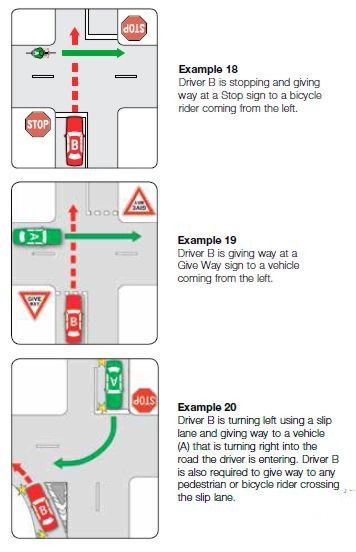
At an intersection, if y'all are facing a Stop sign/line or a Give Style sign/line, y'all must give way to a vehicle coming from whatever other direction (Examples eighteen and 19) except:
- if going straight ahead, to an oncoming vehicle turning correct if a End sign/line or Give Way sign/line applies to the other vehicle
- to a vehicle turning left using a slip lane (Case 20)
- to a vehicle making a U-turn.
If turning left or right at the intersection, you must also give way to whatsoever pedestrian crossing the road you lot are entering.
(Example 23).
If you are proceeding straight alee and a pedestrian is intending to cross the road, you must drive with due intendance and attending and, if necessary, take action to avert a collision.
Yous must likewise requite way to any vehicle or pedestrian at or most a Stop sign/line or Give Fashion sign/line at whatsoever other identify.
Stop signs and Requite Manner signs are described in more item nether Road Signs. come across here
Importantly, if you are approaching a Give Fashion sign/line, and in that location is no danger of colliding with another vehicle or a pedestrian or bicycle passenger crossing the road, yous practise not accept to terminate at the Give Way sign/line before proceeding merely yous must wearisome down and set to stop if this becomes necessary.
Giving way when turning left from a Sideslip Lane
You must requite way to whatsoever pedestrian or wheel rider on, or entering the slip lane and to any vehicle approaching from your correct including an oncoming vehicle that has turned right at the intersection (Example 20).
A skid lane is an area of road for vehicles turning left that is separated at some signal by a painted island or traffic island.
Giving way at T-intersections
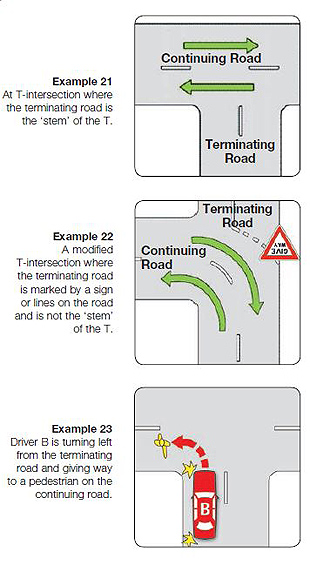 A T-intersection is where two roads run across; one that continues and one that terminates. At well-nigh intersections, ane road will physically terminate and information technology is important to sympathise which is the 'terminating' road and which is the 'continuing' road:
- if there are no road markings or signs indicating otherwise, the terminating road is the 'stem' of the 'T' (Instance 21)
- when there are road markings or signs indicating otherwise, the terminating road tin exist either of the roads that encounter at the T-intersection. This is a modified T-intersection (Example 22).
If you are on the terminating road, you must give mode to all vehicles approaching from either management on the continuing road and to any pedestrian at, near or crossing a continuing road.
Examples 23 and 24, show a vehicle giving way when approaching the intersection where the terminating road is the 'stem' of the 'T' and there are no traffic lights, road markings or signs.
Examples 25 and 26, prove that when turning right from the continuing route, you must also requite way to any approaching traffic including whatever vehicle turning left into the terminating route.
You must too give way to whatever pedestrian or bicycle rider crossing the route you are entering.
 Giving way at Y-intersections
At a Y-intersection, you should Give Way to the right unless in that location are signs and road markings indicating otherwise.
Giving style to oncoming traffic when turning right
Earlier starting to turn right, you must give way to vehicles budgeted from the reverse direction to you, including vehicles turning left (Examples 28 and 29), simply not if they are turning left from a slip lane (Example 20). If you lot are driving on a continuing road at a modified T-intersection and intend to turn into the terminating road, you are 'turning right' and yous must give fashion (Instance 27) to oncoming traffic on the standing road. Yous must too give a right plow point.
Giving mode to pedestrians when turning
If y'all are turning at an intersection, yous must requite way to whatsoever pedestrian who is crossing the road you lot are turning into (Examples 30 and 31). You lot must also Give Way to a pedestrian or bicycle rider who is entering or crossing a sideslip lane if you are turning left at the slip lane.
Giving way when leaving a parking space
When leaving a parking space at the edge of the road or moving off from the kerb, you lot must requite style to whatever vehicles, including motorcycles and bicycles, travelling along the road. You must also give a change of direction signal for at to the lowest degree v seconds to warn other road users.

Instance 27 shows a driver wishing to enter a terminating route from a continuing road at a modified T-intersection. Even if the road is straight ahead, you must signal and Give Way to all other road users on the continuing route. Vehicle A is on the continuing road at all times. Vehicle B is leaving the standing road to enter the terminating road. Vehicle B must Give Way to vehicle A because it is turning across the path of an oncoming vehicle.
Giving way when doing a U-turn
You must give fashion to all vehicles and pedestrians when doing a U-turn and a iii-point turn.
run into hither
Giving way when turning or doing a U-turn at a break in a median strip
You must give way to whatsoever vehicles on the roadway of a divided road you lot are entering through a break in a median strip (Example 36). The median strip might be a narrow grassed strip or wide plenty to crave a curt 'crossover' route (Example 37).
Y'all must also give way to any oncoming vehicle already in the pause in the median strip that is waiting to turn.
Giving manner to the correct at intersections without lights, signs or route markings
You must give way to whatsoever vehicle, including bicycles, approaching from the correct at an intersection not controlled by signs or traffic signals and not a T-intersection. This is known as the 'Requite Way to the Right' rule (Examples 32, 33, 34 and 35).
At intersections without traffic lights, road signs or road markings, that are not T-intersections, yous must give way to any vehicle approaching from your right. This is known every bit the 'Give Way to the Right' rule.
This is highlighted in examples 32, 33, 34 and 35.
It doesn't matter if one vehicle is turning and the other going straight ahead, at an intersection not controlled by signs or traffic signals, that is not a T-intersection, you must give mode to the right.
Giving way when lines of traffic merge
If you are on a road where the traffic is merging from two lines to one line, y'all must requite way to a vehicle on your left or right if any part of that vehicle is alee of your vehicle. This is called the Naught Merge (Example 38).
The Cipher Merge does non apply where lane lines are marked between the vehicles and ane lane is ending (Example 39) such as at the terminate of overtaking lanes and when inbound the superhighway.
Giving way when changing lanes
If y'all are driving on a multi-lane road and desire to move into another lane of traffic, either to your correct or left, yous must first check that it is rubber to change lanes, give a change of management indicate clearly for long enough to warn other road users, and give mode to traffic in the other lane (Examples 39 and 40). This also applies to bike lanes and where the road is wide plenty for two lines of traffic but at that place are no lanes marked on the road (Example 41).
Giving way when entering or leaving a route-related area
When driving into or out of a road-related surface area (such as a driveway or auto park - see Glossary) or adjacent land, y'all must give fashion to all vehicles, bicycles and pedestrians on the road, footpath or route-related area (Examples 42 and 43).
Giving Mode to emergency vehicles
You lot must requite fashion to a police or emergency vehicle with a warning siren sounding or displaying red and/or blue flashing lights to ensure that it is provided with a clear and uninterrupted passage.
Giving mode at roundabouts
You must Give Way to any vehicles already on the roundabout. Remember to look out for wheel riders at roundabouts. How to bulldoze through single-lane and multi-lane roundabouts is described in more detail in the following department.
Source: https://mylicence.sa.gov.au/road-rules/the-drivers-handbook/giving-way
0 Response to "you Must Wait 35 Secs Before Switching Again"
Post a Comment